

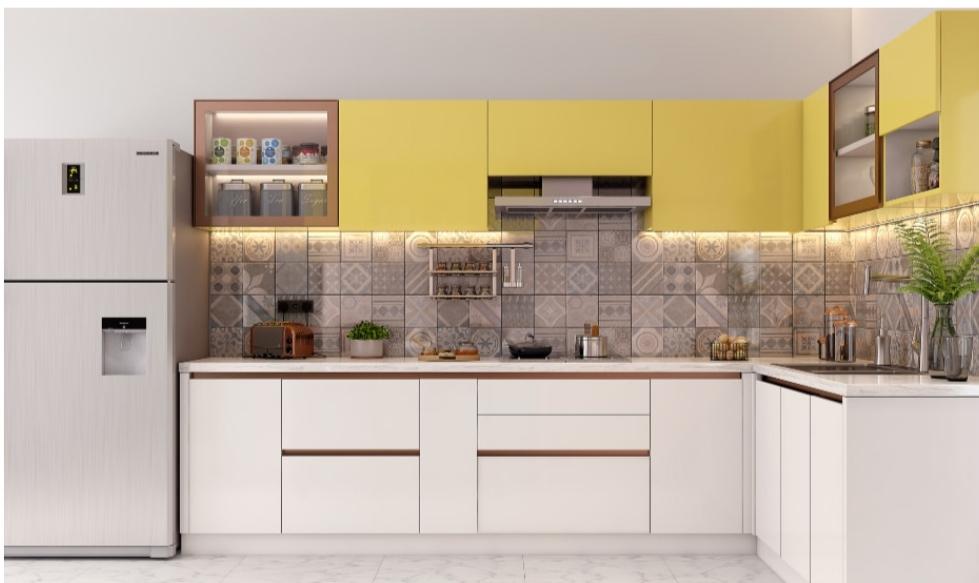
If you want the short answer, the best modular kitchen manufacturer in Bhopal is the one that can prove five things before you pay: factory-made production, the right cabinet material for your usage, branded hardware, a line-by-line quotation, and dependable local service after installation. A modular kitchen is a kitchen made from pre-designed cabinet modules such as base units, wall units, drawers, and tall units that are measured, manufactured, and then fitted on site. Use this guide to compare vendors on evidence, not showroom photos.
TL;DR: Start by asking what the cabinets are made of, which hinge and channel brands are included, how much work is finished before dispatch, and what service response you can expect in Bhopal after handover. The strongest vendors answer in specifics, cite materials and hardware by name, and show completed work plus a detailed quote.
If you want to see the kind of proof worth asking for, review completed work on Davenport India’s Projects page and Modular Furniture page.
Start with these six questions:
Is the kitchen factory-made before dispatch, or is major cutting and fitting still done at home?
What is used for the cabinet structure: plywood, moisture-resistant board, aluminium, or another system?
Which hardware brand and series are included for hinges, channels, lift-ups, and organizers?
Does the quotation break out materials, hardware, accessories, installation, and after-sales support line by line?
How many days do measurement, approval, production, delivery, and final installation usually take?
Who handles service in Bhopal if a hinge loosens, a drawer needs adjustment, or a shutter goes out of line?
A good manufacturer should answer all six clearly and without vague words like “premium” or “best quality.”
In Bhopal, buyers often compare local carpenters, design studios, and factory-based modular kitchen companies. The problem is that many of them use the same language: customized, durable, premium, modern. Those words do not tell you how the kitchen will perform after one year of daily use.
A real kitchen has to handle:
Steam
Heat
Water splashes
Oil stains
Heavy utensils
Groceries
Repeated opening and closing
Daily cleaning
That is why construction quality, finish quality, measurement accuracy, and after-sales support matter more than brochure language.
Before comparing manufacturers, it helps to understand a few common kitchen terms:
Cabinet structure: the inside body or box of the kitchen cabinets. This is where strength starts.
Shutter: the visible front door of the cabinet or drawer.
Hardware: moving parts like hinges, channels, handles, lift-up fittings, and organizers.
Edge banding: the protective strip applied on panel edges. It improves finish and helps protect the board edges.
Finish: the surface look and touch, such as laminate, acrylic, PU, glass, or veneer.
Layout: the shape of the kitchen, such as straight, L-shaped, U-shaped, parallel, or island.
Work triangle: the movement path between the sink, hob, and refrigerator.
These terms matter because the best modular kitchen manufacturer should be able to explain them in plain language, not hide behind jargon.
This is one of the most important buying points. Some sellers market a kitchen as modular, but they still do a large share of cutting, fitting, and finishing on site like traditional carpentry. A truly factory-made process usually means panels are machine-cut, edge-finished properly, drilled with better consistency, and dispatched in prepared form.
That usually leads to:
Cleaner installation
Better shutter alignment
More consistent finish
Less site mess
Faster final fitting
A simple question to ask is: What percentage of the kitchen is completed before it reaches my home?
This is also where Davenport India has a practical angle that many other companies miss. On Davenport projects, the team pushes as much preparation as possible into the factory stage so the home site becomes an assembly and finishing exercise rather than a cutting workshop.
First-hand note: In Davenport installations, the biggest site slowdowns usually happen when civil work, electrical points, or appliance dimensions are not finalized before manufacturing begins. That is why serious manufacturers insist on proper measurement and approval before production.
Many buyers focus first on how the shutters look, but the cabinet structure does most of the heavy work. The cabinet structure is the load-bearing box behind the visible shutter, while the finish is the outer surface you see and touch.
Common cabinet options may include:
Plywood
Moisture-resistant boards
Aluminium systems
Other engineered boards
Each option balances strength, moisture resistance, screw holding, finish compatibility, and cost differently.
If a seller offers engineered wood, ask what standard it follows. This matters for both quality and indoor air considerations. For context, the U.S. Environmental Protection Agency sets formaldehyde emission limits for composite wood products at:
0.05 ppm for hardwood plywood
0.09 ppm for particleboard
0.11 ppm for MDF
Source: U.S. EPA, Formaldehyde Emission Standards for Composite Wood Products
https://www.epa.gov/formaldehyde/formaldehyde-emission-standards-composite-wood-products
That does not mean every kitchen in Bhopal should be judged by U.S. standards alone, but it gives buyers a concrete benchmark to discuss when comparing engineered materials.
Easy rule: the outer look attracts you, but the inside box decides how the kitchen performs after years of use.
A kitchen in Bhopal is not just a decorative room. It has steam, hot vessels, oil, water splashes, storage load, and frequent cleaning. So ask practical questions:
Which areas get moisture-resistant material?
How is the sink unit protected?
What happens near the hob and chimney zone?
Is the layout planned for daily family cooking or just showroom appearance?
Are easy-clean surfaces used in splash-prone areas?
A good manufacturer designs for real use, not just a photo-friendly finish.
This is especially important for families who cook heavily at home. A kitchen that looks elegant in a catalog can perform poorly if the sink zone, edge sealing, or internal hardware selection is weak.
Hardware means the moving components of the kitchen: hinges, drawer channels, tandem systems, lift-up fittings, baskets, and pull-outs. These parts decide how the kitchen feels every day because you use them constantly.
That is why branded hardware matters. As one clear benchmark, Blum says its cabinet hinges are tested for 200,000 opening and closing cycles.
Source: Blum, Product quality
https://www.blum.com/in/en/company/quality-innovation/product-quality/
This gives buyers a useful standard for comparison. Even if a manufacturer uses another brand, they should still be able to name it, explain its warranty, and clarify whether soft-close hardware is included.
Ask for:
Brand name
Product series
Warranty details
Soft-close inclusion
Whether the same hardware is used across all shutters and drawers
A detailed quotation should never say only “premium hardware.” It should tell you what you are actually getting.
A modular kitchen only works when the measurements work. Small errors create bigger problems later:
Uneven gaps
Shutters hitting each other
Poor appliance fitting
Wasted corner space
Uncomfortable movement
Chimney or refrigerator clearance issues
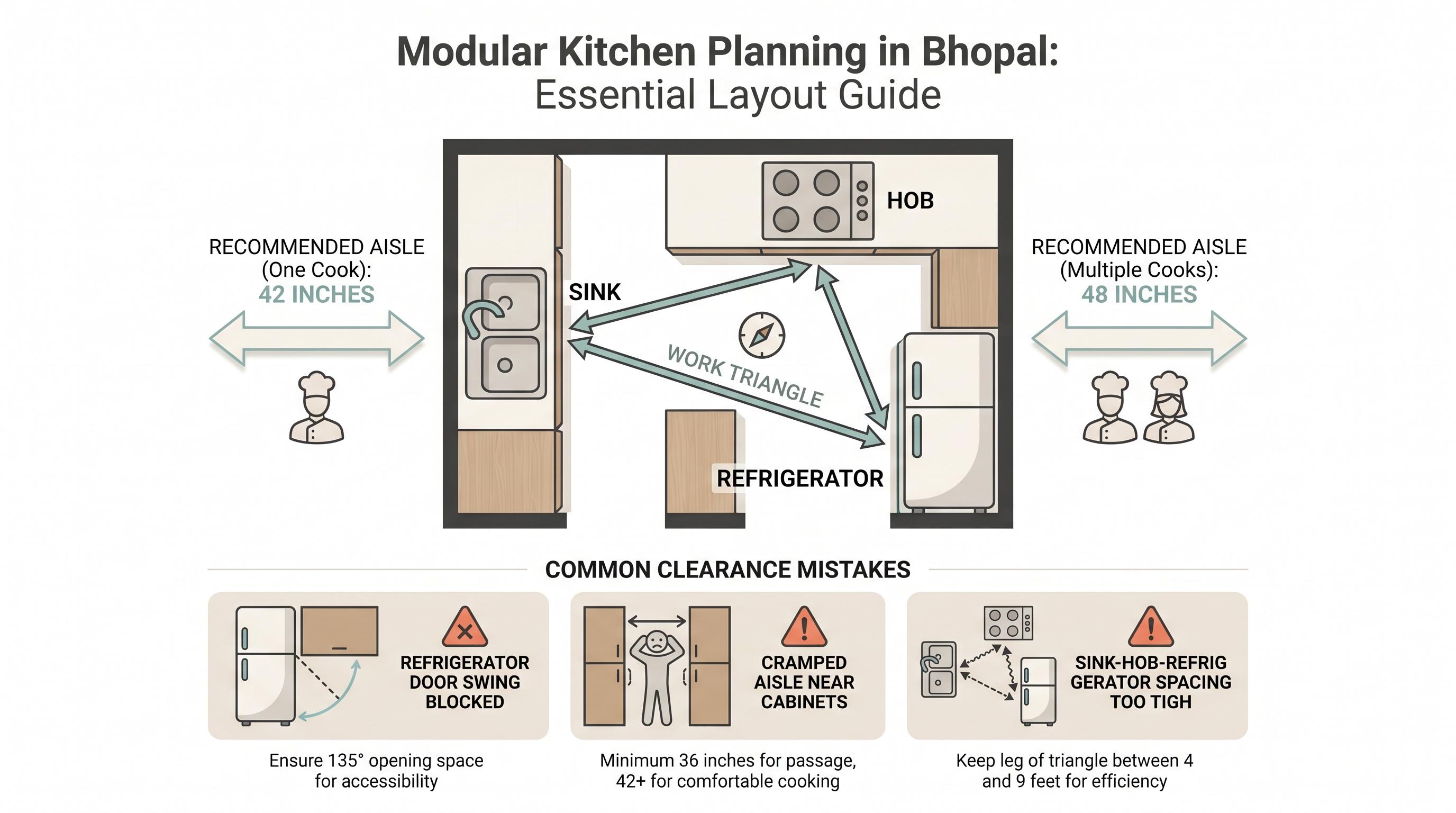
The work triangle means the travel path between the sink, hob, and refrigerator. When that path is poorly planned, cooking becomes less efficient.
The National Kitchen and Bath Association recommends a work aisle of at least:
42 inches for one cook
48 inches for multiple cooks
Source: NKBA Kitchen Planning Guidelines
https://media.nkba.org/uploads/2022/05/Kitchen-Planning-Guidelines.pdf
That guideline is useful because it turns “good layout” into a concrete measurement discussion.
In Davenport home consultations, corner units, chimney clearances, and refrigerator door swing are some of the most common places where rushed measurements create expensive corrections later.
A smart buying question is: Why are you recommending a straight, L-shaped, parallel, or U-shaped layout for my kitchen specifically?
If the answer sounds generic, the planning may also be generic.
Finishing quality is where good manufacturing becomes visible. Look at:
Edge banding
Joint lines
Alignment
Handle fitting
Shutter gaps
Internal finishing
Better edge finishing usually means cleaner lines and better protection of exposed panel edges. Poor finishing often shows up as rough corners, visible mismatch, weak sticking, or inconsistent gaps.
Do not judge only from a single sample board in a showroom. Ask to see completed kitchen work from real homes. Davenport India’s Projects page is a useful example of the kind of completed work buyers should ask every manufacturer to show.
Many buyers compare only the final amount, but that creates confusion. One company may include cabinet material, shutters, hardware, accessories, delivery, installation, and site adjustments. Another may leave some of those out and still appear cheaper.
Always ask for an itemized quotation. At minimum, it should break out:
Cabinet structure material and thickness
Shutter finish and edge treatment
Hardware brand, model, or series
Accessories and internal organizers
Countertop and appliance scope, if included
Delivery, installation, and site adjustment charges
Warranty and after-sales terms
A clear quote usually signals a more professional process. A vague one usually creates disputes later.
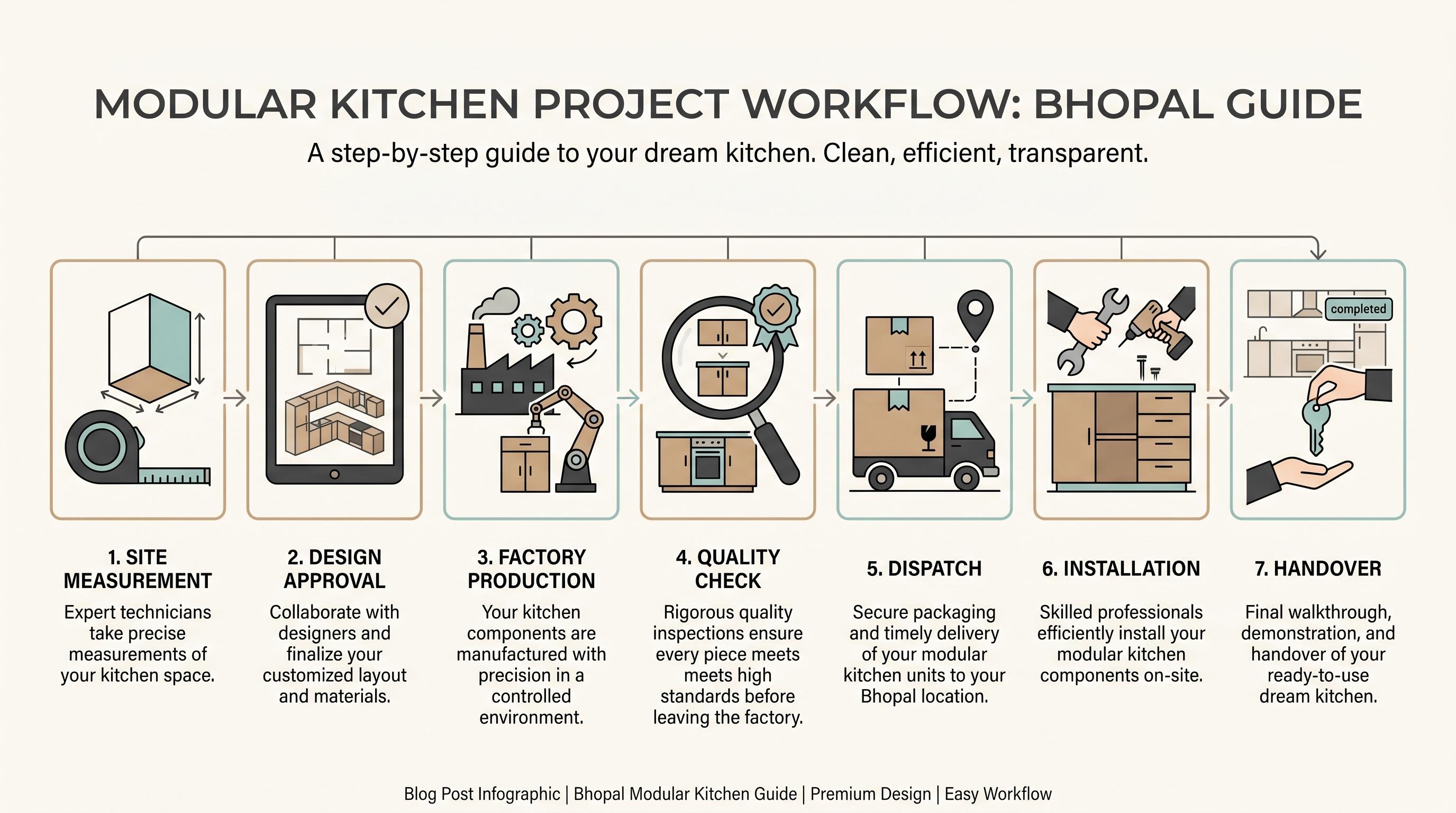
Ask for a real timeline, not a verbal promise. The process should include:
Measurement
Design approval
Production
Dispatch
Installation
Final handover
If a company cannot explain the sequence, the timeline is not under control.
Check Davenport India’s Projects page. We do installation and delivery in half a day when the modules are prepared before dispatch. That is a useful first-party benchmark because it is tied to a specific operating model rather than a generic claim.
This does not mean every project will finish that quickly. Site readiness, wall condition, utility points, and appliance coordination all affect the actual duration. But it does show why factory preparation matters.
The buying decision should not end on installation day. Ask what happens if:
A hinge becomes loose
A drawer does not slide smoothly
A shutter needs adjustment
An accessory fitting needs replacement
Alignment changes after use
Good after-sales support matters even more in a customized kitchen because replacements and adjustments must fit the original design.
For buyers in Bhopal, local service matters. It is easier to trust a manufacturer who can explain service response clearly than one who disappears after payment.
The company cannot clearly explain material differences.
The quotation is vague or incomplete.
No one names the hardware brand.
The installation timeline is only verbal.
The seller relies only on catalog images.
They avoid discussing service terms.
They use phrases like “premium” and “best quality” but provide no technical explanation.
Most generic search results on this topic stay broad. They tell you to check quality, compare prices, and read reviews. That advice is not wrong, but it is not enough for a high-value kitchen decision.
A stronger approach is to compare on five proof points:
Factory-readiness before dispatch
Cabinet material and emissions benchmark
Hardware brand and durability benchmark
Measured layout standards
Written scope, timeline, and service response
That is the difference between buying on marketing language and buying on evidence.
The best choice is the manufacturer who can show strong process quality, explain technical details clearly, provide a transparent quotation, and support you after installation. Instead of trusting only a claim, compare materials, hardware, finishing quality, timeline, and service terms.
Both matter, but material quality and execution matter more over time. A beautiful kitchen with a weak internal structure or low-grade fittings may look good on day one and create problems later.
In many cases, yes. A factory-made setup usually gives better cutting accuracy, neater finishing, faster installation, and less site mess. The final result still depends on the manufacturer’s process and quality standards.
Compare the cabinet structure material, shutter finish, hardware brand, included accessories, installation scope, and warranty terms. Do not compare only the total price.
Ask about materials, hardware, manufacturing method, installation timeline, quotation details, warranty, and local service support. Those answers tell you far more than brochure language.
Judge a modular kitchen manufacturer on proof, not photos.
Ask specific questions about cabinet material, hardware brand, and service response.
Ask for a line-by-line quotation and a written timeline before you commit.
Review completed work before shortlisting any vendor.
The best modular kitchen manufacturer in Bhopal is not the one that simply says “best.” It is the one that can prove quality in a practical, easy-to-understand way. When you understand the technical basics, ask for named materials and hardware, and compare quotations line by line, you stop buying on guesswork and start buying on evidence.
If you are planning a new kitchen, the smartest next step is a site visit, proper measurement, and a quotation that clearly explains materials, hardware, layout, timeline, and service support. Start with Davenport India’s Projects page, explore Modular Furniture, or book a consultation via the Contact page.


Factory made customized furniture and complete interior and renovation projects for apartments, bungalows, offices, residential and commercial projects.